


How one Indian man spent five years travelling to London to demand compensation from the East India Company
- A Passage To Europe Rahul Markovits Saqi Books £25, 352pp
The next time you’re delayed for hours at an airport, or bumped off your flight and made to wait for 24 hours, spare a thought for Ahmad Khan. In the late 18th century, he set off as part of the entourage of three high-born sons of the deceased nawab (Muslim governor) of Broach (now Bharuch) in India, heading to London. They intended to petition the directors of the East India Company for pensions to sustain them after the company’s ruthless looting and plundering of Broach had left them destitute.

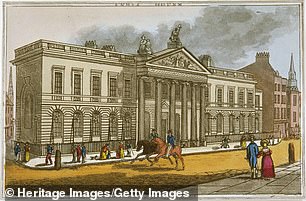
East India House
The party got stuck for six months in Baghdad because of a rebellion; then, after a 1,200-mile trek across the desert, they were stuck for eight months in Constantinople; then Ahmad and the nawab’s son he was accompanying, Navasish Khan, were quarantined in Marseilles for a month; then they were stranded in Revolutionary Lyon for a year while it was under siege. Their hotel was shelled 42 times, and poor Navasish dropped dead from a probable stroke.
Proceeding northwards alone, Ahmad spent seven months holed up in Versailles because France had declared war on Britain and would not grant him passage to the enemy country. This time wasn’t wasted. The cross-cultural broker whom Ahmad stayed with, a man called Ruffin, taught him French. There still exists a bilingual version of the Declaration Of The Rights Of Man in Ahmad’s handwriting, in both French and Persian.
After he was granted permission and funding to travel on to London via Switzerland, he spent two months in a hotel in Haymarket before returning home again, via Lyon, where he collected Navasish’s body in a 3ft-long coffin (his limbs had been chopped off for flat-packed portability, Ikea-style). With great loyalty, Ahmad had vowed to repatriate Navasish’s body so he could be buried in his homeland.
On that journey home, in Constantinople, Ahmad was spotted as a guest of honour of the French. The sultan was ‘struck by the sight of a Muslim in the retinue’. Who on earth was he? It’s this very question that sleuthing author Rahul Markovits aims to answer in this brilliantly researched book.
Its subtitle, The Extraordinary Travels Of An Indian Prince In The Age Of Revolutions, turns out to be rather misleading. In France, Ahmad did claim to be one of the sons of the nawab, so a sort-of prince. But Markovits surmises that he was in fact probably a ‘sepoy of fortune’ – a mercenary soldier from Afghanistan, the paid companion of Navasish. He passed himself off in France as a ‘son of the nawab’ in order to obtain more offers of assistance on his travels.
The good news was that, when it came to the central matter of compensation from the East India Company, the expedition was ‘vaut le voyage’. Thanks to his fervent petitioning in London, Ahmad was given 400 guineas, on condition that he return to India without incurring any further expense to the company.
The bad news was that, at the moment of his arrival back in India, he was arrested, suspected by the British of being a spy for the French.
The East India Company’s Nathan Crow was eager to make his mark and chalk up an early success in the intelligence war against France. The British were convinced Ahmad was carrying secret letters from the French to their arch-enemy in India, Tipu Sultan. They opened Navasish’s coffin and searched under the lid, but found nothing incriminating. Yet still they cross-examined Ahmad, charged him with treason and ‘entertained him in safe custody’ (in other words imprisoned him) for the next three years.
In a prototype of how MI6 runs, civil servant and spymaster William Wickham was putting his network of informants in the service of the East India Company.
That was the net in which Ahmad was caught up and scapegoated. The story of Ahmad’s remarkable journey and quest for justice shines a torch on the deeply dubious methods of the British as they colonised India.