


Why treasure is always best left buried
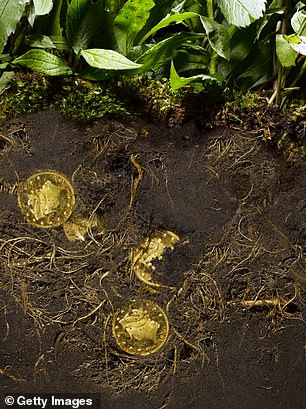
- Treasures On Earth by Jeremy Harte (Reaktion Books £15.99, 296pp)
One of the oldest poems of the English people, Beowulf, ends with the burial of treasure, but it is a melancholy moment, the hoard ‘a crumbling legacy from a lost world’, after which the survivors drift off into exile, ‘the worst of Anglo-Saxon fates’. Beneath the gleam and promise of gold and jewels, there always lies tragedy and menace.
Treasures On Earth, by Jeremy Harte, is an evocative portrait of the landscapes inhabited by our forebears. It also shows how far back folk memories can stretch: at least one tale, from Beauworth in Hampshire, records how King

Treasure buried beneath our feet
Stephen’s crown jewels are hidden down the well behind the Fox and Hounds pub, a legend that must go back nearly 1,000 years.
The idea of buried treasure has an obvious appeal. Someone else did all the hard work generations ago, mined the gold, accrued it and buried it. Now, with just a few well-judged thrusts of a spade, you can become instantaneously rich. Perhaps it’s akin to the dreams of today’s metal detectorists or fantasies of winning the lottery.
Former dreamers include some wonderfully eccentric characters, such as Mary Parish, ‘fat, fond of brandy, and given to sudden outbursts of temper’, and her colleague Godwin Wharton, ‘the impoverished younger son of a Whig grandee’. They first met in 1683, when Mary was 52, and Wharton, mentally unstable (as well as an MP, please note) fell under her spell. Soon he was buying her pure white candles, herbs and flowers for her fairy incantations, and later they ventured out on to Hounslow Heath, which she was sure was a gateway to the upper world for subterranean fairies. They found a mound surrounded by four elm trees, where she claimed a vast treasure had lain buried since the reign of King John, though they never actually found it. Yet ‘they never doubted, never gave up, and hardly ever quarrelled’, says Harte. ‘Only the cruellest of fairies would have ended their happiness by producing an actual cache of coins.’
Many tales and anecdotes here seem simultaneously borderline bonkers, fabulously imaginative and grimly moralistic all at once. Take note of ‘the man who dared face the black hen of Chiddingly, and ended up a cripple in a cradle’ or those who disturbed barrows or standing stones to look for buried treasure, only to end up squashed flat, or else pursued to the point of madness by a monstrous black dog or a raven. There is often, says the author, ‘an unseen link between buried treasure and hidden violence’.

Treasures on Earth is available now
It’s oddly reminiscent of modern folkloric tales in which someone finds a huge stash of drugs money (eg Danny Boyle’s Shallow Grave) or even the drugs themselves – but then what? Staggering riches, suddenly and ill-deservedly acquired, rarely end well.
Harte closes his beguiling survey with the simplest and neatest of tales. At Wallingford, Oxfordshire (although originally Berkshire before redrawing of boundaries), a gardener was convinced a secret cache of gold lay hidden in the grounds of the old medieval castle there, and was forever digging holes nearby, stacking the turves in neat piles beside them to replace later.
He went missing and all that was found was a small, freshly dug hole, his gloves and spade laid beside. He was never seen again…
Did he find his treasure and retire to a palatial villa in the Caribbean? Or did the story have an altogether darker ending? We will never know…