

Need more joy? Be more farmer
- The Wisdom of Farmers by John Connell (Allen & Unwin £12.99, 256pp)
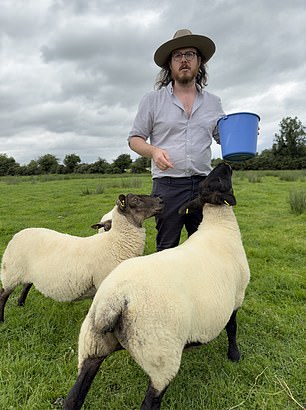
Ten years ago, John Connell gave up his job as a film producer and investigative journalist to go and work on his family’s farm in Ireland. The transition wasn’t an easy one: he missed concrete and skyscrapers and the buzz of city life. Gradually, though, his perception changed, as he developed what he calls ‘my earth eye’.

John Connell with sheep
The earth eye is a concept that runs throughout this book. ‘It’s a gift that nature gave to me, but it is a gift we all can have,’ Connell writes, adding helpfully: ‘One doesn’t need a farm to have an earth eye.’ But what is it exactly?
It seems to involve ‘swapping the digital for the real’, ‘finding our purpose in fellowship with the earth’, and making time for a daily session with nature. ‘Use your earth eye to see that nature can be everywhere – the urban flowering weed is just as alive as a rose in a well-tended garden.’
Setting out a 12-step plan, Connell exhorts us to be – and think – more like a farmer. His admiration for his fellow farmers knows no bounds. He calls them ‘the first stoics’, resilient people who for millennia have philosophically accepted droughts, floods, crop failures and dead livestock because ‘life is governed by nature… we can endure because we can’t control everything’.
Like farmers, he says, we should get up early and relish seeing the sun rise and hearing the dawn chorus. We need to seek out the joy in our daily life. Despite farmers having a reputation for irascibility – and who can blame them, what with erratic weather and fuel prices and a government seemingly hell-bent on taxing them out of existence – Connell maintains that farmers ‘trade in the business of joy, from lambing to the flowering of a vegetable or the ripening of a fruit’.
At one point Connell says nervously: ‘I hope the wisdom I have shared is not wishy-washy.’ In truth a lot of his advice is fairly obvious stuff: buy local, look after your health, have a flexible mindset, accept stress and failure as part of life.
The best section is on the power of joining forces and helping others. When Connell’s uncle Mick died, it was the height of the silage season. As his family struggled, neighbours arrived unannounced with their tractors to bring home the bales for one final time. No one had asked them to do this, but ‘the word had gone out and they assumed that this was the right thing to do’.
While this book may not convert you to the idea of thinking like a farmer, it’s hard to disagree with its contention that we need to do all we can to stand up for farmers and their vital work. Even those of us who rarely set foot in the countryside are inextricably linked with farming, and our food-buying choices can make a huge difference. As Connell says: ‘We only vote for politicians every four or five years, but we vote for a farmer every day, every week and every year.’